Ohm's Law Explained: Calculating Voltage, Current, and Resistance
Master the foundational law of electronics. We explain Ohm's Law, how to use the formula triangle, and practical applications in daily circuit design.
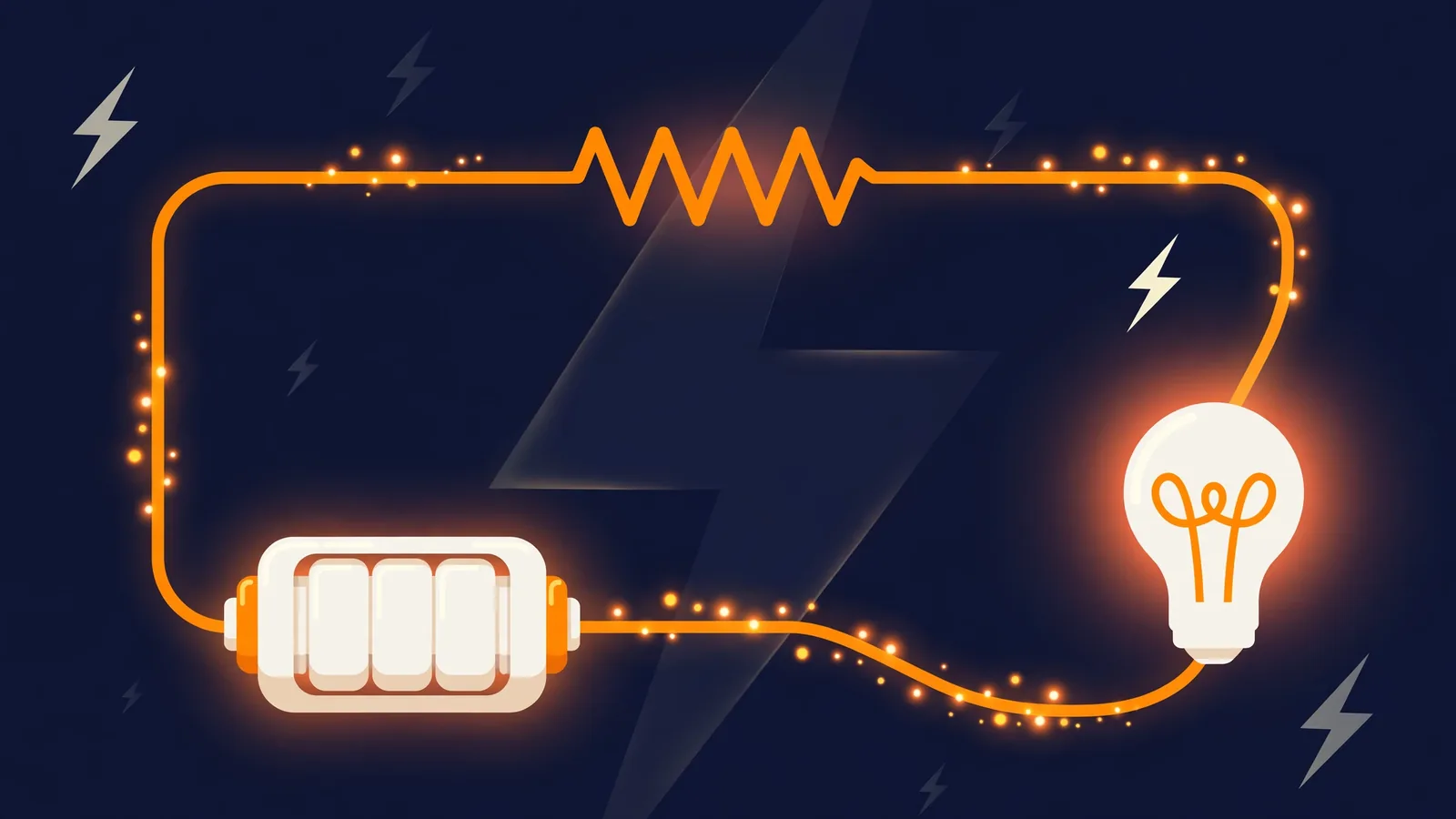
Calculate electrical values instantly using our free Ohm's Law Calculator, or read on to understand the fundamental math that powers modern electronics.
Named after the German physicist Georg Simon Ohm, Ohm's Law is the most fundamental relationship in electronics. It describes how voltage, current, and resistance interact within an electrical circuit. Whether you are designing a complex microchip or simply trying to figure out which resistor to use for an LED, Ohm's Law is your starting point.
The Three Pillars of Electricity
Before understanding the formula, you must understand the components:
- Voltage (V or E): Measured in Volts (V). This is the "pressure" or force that pushes electrons through the circuit. Think of it as water pressure in a pipe. 2. Current (I): Measured in Amperes or Amps (A). This is the flow rate of the electrons.
Think of it as the amount of water flowing through the pipe. 3. Resistance (R): Measured in Ohms (Ω). This is the friction or opposition to the flow of electrons. Think of it as the pipe's diameter—a narrower pipe restricts water flow just as higher resistance restricts current.
Enter your own numbers and see the result instantly — free, no signup.
The Formula
Ohm's Law states that the current through a conductor is directly proportional to the voltage across it, and inversely proportional to its resistance.
V = I × R
Depending on what you are trying to find, you can rearrange the formula mathematically:
- To find Current: I = V / R
- To find Resistance: R = V / I
The Ohm's Law Triangle
Engineers often use a visual aid called the Ohm's Law Triangle. Place V at the top, and I and R at the bottom.
- Cover the letter you want to find.
- If the remaining letters are side-by-side, multiply them.
- If one is over the other, divide the top by the bottom.
Adding Power to the Picture
Circuits do work — lighting bulbs, heating elements, spinning motors — and power measures how fast that work happens. Power (P) is measured in watts.
Watt's Law: P = V × I
A lamp on a 120V circuit drawing 0.5A consumes 120 × 0.5 = 60 watts. That is exactly what the bulb's packaging promises.
Combining Watt's Law with Ohm's Law produces two more workhorse formulas:
P = I² × R— power from current and resistance. A 2A current through a 10Ω resistor dissipates4 × 10 = 40 wattsas heat.P = V² / R— power from voltage and resistance. A 12V supply across a 6Ω load delivers144 / 6 = 24 watts.
Together with the triangle, these three formulas answer nearly every basic circuit question. Our Electric Power Calculator solves all of them directly.
Practical Example: Wiring an LED
Let's say you want to wire a standard Red LED to a 9-volt battery.
- The battery provides 9V.
- A typical Red LED requires a forward voltage drop of about 2V and operates safely at 20mA (0.02A) of current.
Because the battery provides 9V and the LED only needs 2V, you must use a resistor to drop the remaining 7V (9V - 2V).
Using Ohm's Law to find the required resistor:
- R = V / I
- R = 7V / 0.02A
- R = 350 Ω
You need a 350-Ohm resistor to safely run the LED without blowing it out.
Choosing a Real Resistor Off the Shelf
Here is where theory meets the parts bin: 350Ω is not a standard manufactured value. The nearest common values are 330Ω and 390Ω.
Run the current check for each candidate:
- With 330Ω:
I = 7 / 330 = 0.0212A— 21.2mA, slightly over the LED's 20mA target. - With 390Ω:
I = 7 / 390 = 0.0179A— 17.9mA, safely under, and the LED still lights brightly.
Choose the 390Ω part. When the exact value does not exist, rounding resistance up protects the component, because higher resistance means lower current.
Check the Resistor's Power Rating Too
The resistor converts its 7 volts of dropped pressure into heat. Its power dissipation is P = I² × R = 0.02² × 350 = 0.14 watts.
A standard quarter-watt (0.25W) resistor handles that comfortably. Skip this check on a bigger circuit, though, and an undersized resistor can overheat and fail.
Series Circuits: Resistances Add
Components wired end-to-end form a series circuit. The same current flows through every part, and the resistances simply add.
Two resistors of 10Ω and 20Ω in series behave like a single 30Ω resistor.
On a 12V supply, the current is I = 12 / 30 = 0.4A everywhere in the loop.
The voltage divides in proportion to resistance:
- Across the 10Ω resistor:
0.4 × 10 = 4V - Across the 20Ω resistor:
0.4 × 20 = 8V - Total:
4 + 8 = 12V— matching the supply, as it must.
This voltage-dividing behavior is how many sensors and volume controls work in practice every day. For multi-resistor networks, a Resistance Calculator speeds up the combinations.
Parallel Circuits: Resistances Shrink
Components wired side-by-side form a parallel circuit. Every branch sees the full supply voltage, and the total resistance is less than the smallest branch.
For two resistors, use: R_total = (R1 × R2) / (R1 + R2)
- Two 10Ω resistors in parallel:
(10 × 10) / (10 + 10) = 5Ω - A 6Ω and a 3Ω in parallel:
(6 × 3) / (6 + 3) = 2Ω
Adding a parallel path always lowers total resistance, so total current from the supply rises. This is why plugging in one more appliance draws more current from the wall — each device is another parallel branch.
Household wiring is parallel for good reason: every outlet gets full voltage, and switching one device off does not break the path for the others.
Why Fuses and Wires Care About Ohm's Law
A 1,500-watt space heater on a 120V outlet draws I = P / V = 1500 / 120 = 12.5 amps.
Standard household circuits are commonly rated at 15 amps. The heater alone nearly fills one — add a second heavy appliance and the breaker trips, by design.
Wires themselves have small resistances, and Ohm's Law applies to them too. A long, thin extension cord with 0.5Ω of resistance carrying 10A drops V = 10 × 0.5 = 5 volts along its length.
That cord also wastes P = I² × R = 100 × 0.5 = 50 watts as heat inside its insulation. This is why overloaded extension cords get warm — and why heaters deserve the wall outlet, not the cord.
Common Mistakes
- Leaving milliamps unconverted. 20mA is 0.02A. Plugging "20" into the formula instead gives an answer off by a factor of 1,000.
- Using the full supply voltage for one component. In the LED example, the resistor only drops 7 of the 9 volts. Each component gets its own V in Ohm's Law.
- Assuming resistance is always constant. A cold light-bulb filament has far lower resistance than the same filament glowing hot. Ohm's Law still holds at each instant, but R itself changes with temperature.
- Mixing series and parallel rules. Series resistances add directly; parallel resistances combine reciprocally. One formula does not fit both layouts.
FAQ
Does Ohm's Law apply to all materials? No. Ohm's law only applies to "Ohmic" materials, where the resistance remains constant regardless of the voltage or current applied. Components like diodes and transistors are "non-Ohmic" because their resistance changes drastically depending on the voltage applied to them.
How does electrical power relate to Ohm's Law? Power (P), measured in Watts (W), is the rate at which electrical energy is transferred. Watt's Law states that P = V × I. You can combine Ohm's Law and Watt's Law to find power if you only know resistance and current: P = I² × R.
What is a short circuit?
A short circuit is an accidental path with almost no resistance. With R near zero, Ohm's Law says current explodes toward enormous values — I = V / R with a tiny denominator. Fuses and breakers exist to interrupt exactly this event before wires overheat.
Why is the current identical everywhere in a series circuit? Charge cannot pile up anywhere in a steady circuit — electrons are not created or stored along the wire. Whatever flows into a component each second must flow out, so a single loop carries a single current.
Components differ in how much voltage they drop, never in the current they pass along.
Does Ohm's Law work with household AC power? Yes, for resistive loads like heaters and incandescent bulbs, using the RMS (root mean square) values that AC ratings are quoted in. Loads with motors or electronics involve reactance as well, which extends the same ideas into a broader concept called impedance.
For quick, error-free circuit calculations without doing the algebra yourself, use the CalcUnit Ohm's Law Calculator.