The Ultimate Guide to Calculating Volume (3D Space)
Master 3D geometry. Learn the formulas to calculate the volume of cubes, cylinders, and spheres for packaging, chemistry, and construction.
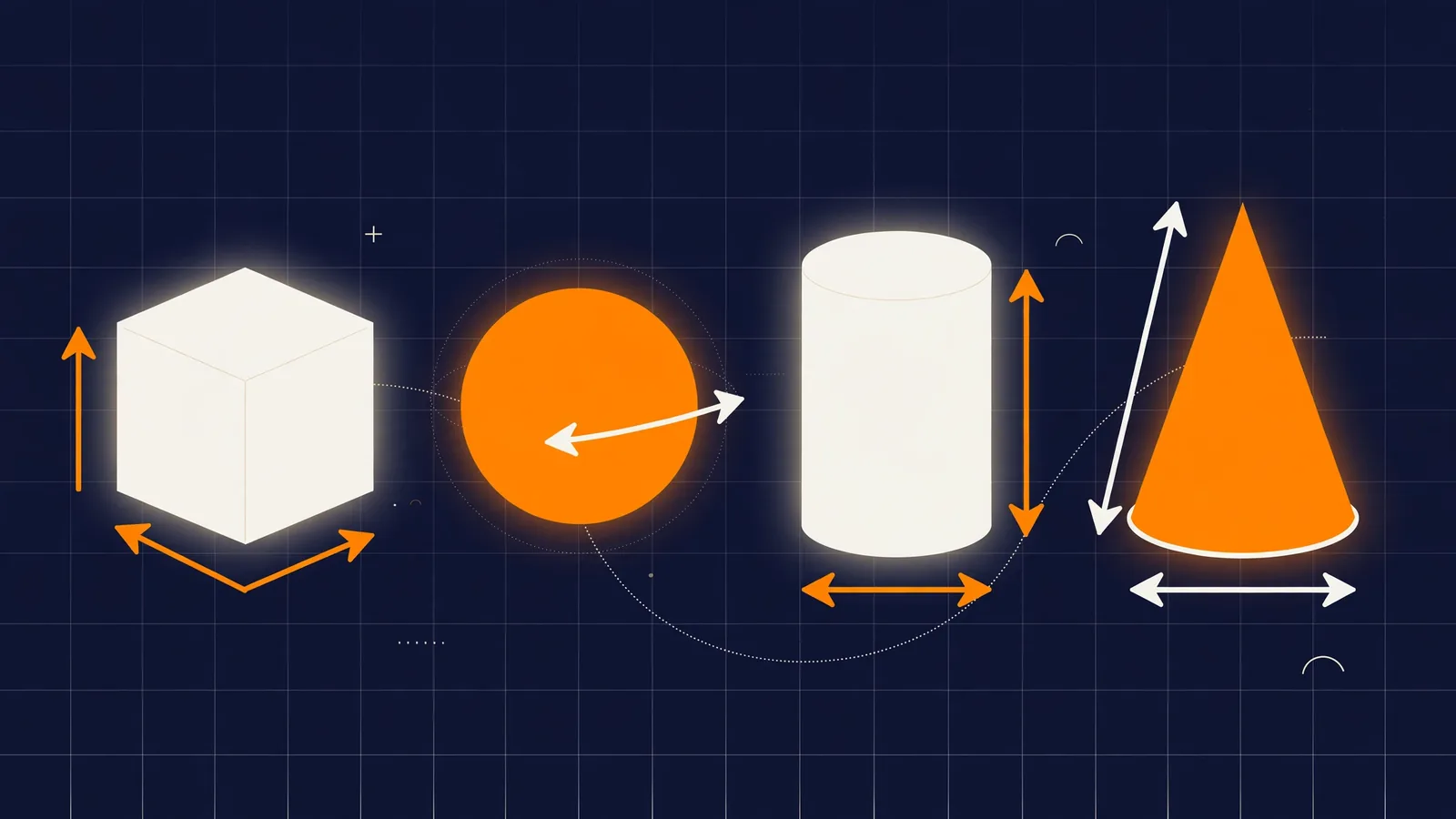
Find the exact volume and liquid capacity of any 3D object using our Volume Calculator, or read on to master the mathematical formulas.
While Area measures 2D flat space, Volume measures the amount of 3-Dimensional space an object occupies. Understanding volume is crucial for chemistry (measuring liquids), logistics (shipping boxes), and construction (pouring concrete).
Volume is always measured in cubic units (e.g., cubic centimeters (cm³), cubic feet (ft³), or liters).
Cubes and Rectangular Prisms (Boxes)
A rectangular prism is just a 3D rectangle (like a cardboard shipping box). A cube is a special rectangular prism where all sides are exactly the same length.
Formula: Volume = Length × Width × Height
Example: A shipping box is 10 inches long, 8 inches wide, and 5 inches tall.
Volume = 10 × 8 × 5 = 400 cubic inches.
For a cube, all three measurements are one side length, so the formula compresses to Volume = side³. A cube with 4-inch sides holds 4 × 4 × 4 = 64 cubic inches.
Doubling a cube's side multiplies its volume by eight, not two — the cube in the formula is unforgiving. That scaling law surprises people in everything from ice cubes to storage units.
Enter your own numbers and see the result instantly — free, no signup.
Cylinders
A cylinder is a 3D shape with two identical flat circular ends and one curved side (like a soup can or a pipe). To find the volume, you first find the area of the flat circle on the top, and then multiply it by how deep the cylinder goes.
Formula: Volume = π × r² × h
- π = Pi (approx. 3.14159)
- r = Radius of the circular base
- h = Height (or depth) of the cylinder
Example: A water tank has a radius of 2 meters and a height of 5 meters.
Volume = 3.14159 × (2²) × 5
Volume = 3.14159 × 4 × 5 = 62.83 cubic meters.
That tank's capacity in liters is just as direct: one cubic meter holds 1,000 liters, so the tank holds about 62,830 liters. Our Cylinder Volume Calculator runs these numbers for any tank size.
Cones and Pyramids: The One-Third Rule
Pointed shapes follow a memorable pattern: they hold exactly one third of the matching straight-sided shape.
Cone formula: Volume = (1/3) × π × r² × h
Example: A cone with radius 3 inches and height 9 inches.
Volume = (1/3) × 3.14159 × 9 × 9 = 84.82 cubic inches.
Pyramid formula: Volume = (1/3) × Base Area × h
Example: A square pyramid with a 6-by-6-foot base and a height of 4 feet.
Volume = (1/3) × 36 × 4 = 48 cubic feet.
The one-third relationship is exact, not approximate — a cone and cylinder with the same base and height always split their combined space 1-to-2.
Spheres
A sphere is a perfectly round 3D object (like a basketball or a planet). Because it has no flat edges or straight lines, the formula relies heavily on Pi and the radius.
Formula: Volume = (4/3) × π × r³
Example: A baseball has a radius of roughly 1.5 inches.
- Cube the radius:
1.5 × 1.5 × 1.5 = 3.375 - Multiply by Pi:
3.14159 × 3.375 = 10.60 - Multiply by 4/3 (or 1.333):
10.60 × 1.333 = 14.13Volume = 14.13 cubic inches.
Converting Volume to Liquid Capacity
In the real world, you often calculate the geometric volume of a container (like a swimming pool) to find out how much liquid it can hold.
The metric system makes this incredibly easy because it was designed around water:
- 1 cubic centimeter (cm³) is exactly equal to 1 milliliter (mL).
- 1,000 cubic centimeters is exactly equal to 1 Liter (L).
If you have a perfectly square box that is 10cm x 10cm x 10cm, its volume is 1,000 cm³. Therefore, it holds exactly 1 Liter of water.
In the Imperial system, the conversion is much harder:
- 1 cubic foot (ft³) is approximately equal to 7.48 US Gallons.
Worked Example: Gallons in a Fish Tank
Aquarium sizes are sold in gallons, but tanks are measured in inches. Bridge the two with the fact that one US gallon equals exactly 231 cubic inches.
A tank measuring 24 × 12 × 12 inches has a volume of 24 × 12 × 12 = 3,456 cubic inches.
Convert: 3,456 / 231 = 14.96. So it is a 15-gallon tank — matching the size printed on the box.
Worked Example: Filling a Swimming Pool
A rectangular pool 20 feet long, 10 feet wide, and 5 feet deep holds 20 × 10 × 5 = 1,000 cubic feet.
At 7.48 gallons per cubic foot, filling it takes 1,000 × 7.48 = 7,480 gallons of water. That number explains many first water bills after a pool installation.
Worked Example: Concrete for a Slab
Concrete is ordered in cubic yards, but slabs are measured in feet and inches. Work in feet first.
A slab 10 feet by 10 feet, poured 4 inches thick, has a depth of 4/12 = 0.333 feet.
- Volume:
10 × 10 × 0.333 = 33.3 cubic feet - Convert:
33.3 / 27 = 1.23 cubic yards(since 1 cubic yard = 27 cubic feet)
Suppliers sell in round increments, and forms are never perfect, so ordering about 1.5 cubic yards covers the pour with a sensible margin. Running short mid-pour is far costlier than a small overage.
Estimating Volume When the Shape Is Almost Regular
Many real containers bend the rules slightly: sloped pool floors, tapered buckets, tanks with rounded ends. Approximate them rather than giving up.
Use the average dimension. A pool that slopes from 3 feet deep to 6 feet deep behaves roughly like a flat pool of the average depth, 4.5 feet.
For the 20-by-10-foot pool, that gives 20 × 10 × 4.5 = 900 cubic feet, or about 900 × 7.48 = 6,732 gallons.
Split the difference deliberately. For a tapered bucket, average the top and bottom diameters before using the cylinder formula.
Round toward safety. For chemicals, fuel, or water orders, an estimate within a few percent is fine — but choose the direction of error that cannot cause a spill or a shortage.
An estimate with a known small error beats a precise formula applied to the wrong shape. The goal is a number you can act on.
More Volume Conversions Worth Knowing
| Conversion | Factor |
|---|---|
| Cubic inches → cubic feet | divide by 1,728 |
| Cubic feet → cubic yards | divide by 27 |
| Cubic meters → liters | multiply by 1,000 |
| Cubic feet → US gallons | multiply by 7.48 |
| Liters → US gallons | multiply by 0.264 |
Notice every factor here is a cube: 1,728 is 12³, and 27 is 3³. If a conversion factor for volume is not a cubed number, double-check it before trusting it.
Volume of Irregular Objects: Displacement
Formulas fail for rocks, keys, and oddly shaped tools. The workaround is ancient: displacement.
Fill a container to a marked level, submerge the object completely, and measure how much the level rises. The risen volume equals the object's volume.
A graduated cylinder makes this precise in a lab. At home, a measuring jug and careful subtraction get you surprisingly close.
This is also how jewelers and scrap buyers sanity-check odd metal pieces — volume, combined with mass, reveals density, and density identifies materials.
Common Mistakes
- Using diameter instead of radius. In sphere and cylinder formulas the error compounds: doubling the radius input multiplies a sphere's volume by eight.
- Forgetting the one-third. A cone computed as a full cylinder overstates the answer by a factor of three.
- Mixing units. Length in inches and height in feet produces a number in no unit at all. Convert first, always.
- Measuring outside instead of inside. A container's capacity comes from its interior dimensions. Thick walls can steal a surprising share of a small box.
FAQ
What is the difference between Volume and Mass? Volume is the amount of physical space an object takes up. Mass is the amount of matter in the object. A balloon full of air and a bowling ball might have the exact same volume, but the bowling ball has significantly more mass.
How is capacity different from volume? Capacity is the volume a container can hold — its interior volume. The volume of the container object itself includes its walls. For thin-walled tanks the two are nearly equal; for a thick-walled cooler, they are not.
Why does a sphere's formula use r³ but a circle's area uses r²? Area grows with two dimensions, so radius enters squared. Volume grows with three dimensions, so radius enters cubed. The exponent always matches the number of dimensions being measured.
Don't risk manual math errors when pouring concrete or calculating shipping logistics. Use the highly precise CalcUnit Volume Calculator.