How to Calculate EMI for Home Loans: Step-by-Step Formula Guide
Learn how to accurately calculate Equated Monthly Installments (EMI) for your home or personal loan. We explain the formula, provide real-world examples, and show how interest rates impact your total loan cost.

Calculate your loan EMI instantly using our free EMI Calculator, or read on to understand the math behind the numbers.
What Is an EMI?
Equated Monthly Installment (EMI) is the fixed payment amount made by a borrower to a lender at a specified date each calendar month. EMIs are used to pay off both interest and principal each month so that over a specified number of years, the loan is fully paid off.
Whether you are applying for a home loan, car loan, or personal loan, understanding how your EMI is calculated is a crucial step in financial planning. This guide will walk you through the EMI formula, provide practical examples, and show you how to easily compare loan options.
The word "equated" simply means equal. On a fixed-rate loan, every monthly payment is the same dollar amount from the first payment to the last, even though the mix of interest and principal inside each payment changes over time.
Enter your own numbers and see the result instantly — free, no signup.
How It Works
The EMI calculation relies on three primary variables:
- Principal Amount (P): The total amount you are borrowing.
- Interest Rate (R): The annual interest rate charged by the lender. (For the formula, we convert this to a monthly rate).
- Loan Tenure (N): The total time you have to repay the loan, measured in months.
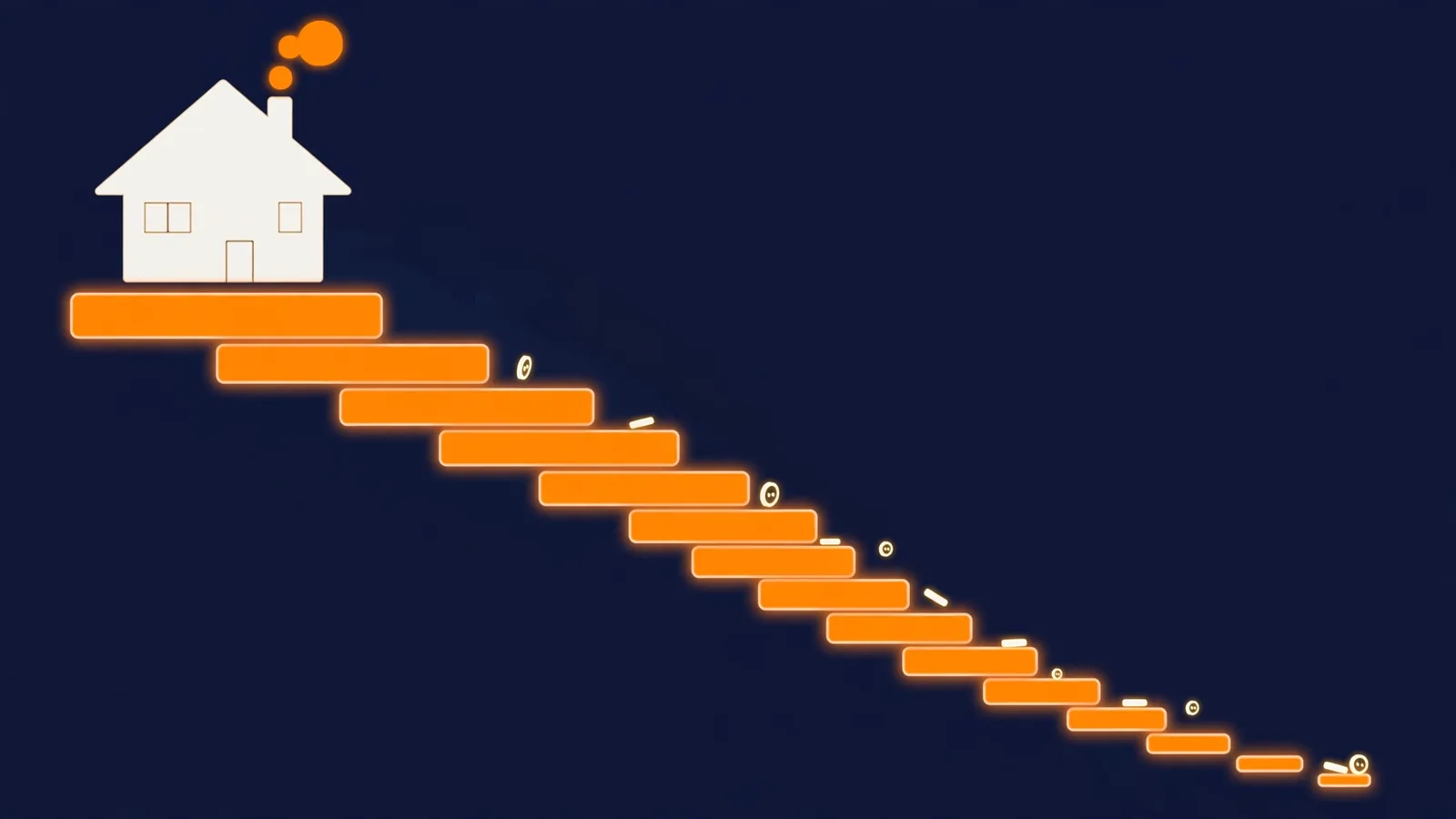
The EMI consists of two parts: the principal repayment and the interest payment. In the early years of a long-term loan (like a mortgage), a larger portion of your EMI goes toward paying the interest. Toward the end of the loan, a larger portion goes toward paying down the principal.
This shifting mix is called amortization. The payment stays level because the formula is designed so that the balance reaches exactly zero with the final payment, no sooner and no later.
The Formula
To calculate the EMI manually, banks and financial institutions use the standard amortization formula.
EMI = [P x R x (1+R)^N] / [(1+R)^N-1]
Where:
- P = Principal loan amount
- R = Monthly interest rate (Annual Rate / 12 / 100)
- N = Number of monthly installments (Loan tenure in years x 12)
Two conversions trip people up most often. First, always divide the annual rate by 12 and by 100 before using it. Second, always express the tenure in months, not years, because interest is charged monthly.
Example Calculation
Let's assume you are taking a home loan with the following details:
- Principal (P): $100,000
- Annual Interest Rate: 6% (So, Monthly Rate R = 6 / 12 / 100 = 0.005)
- Tenure: 10 years (So, Months N = 10 x 12 = 120)
Plugging these values into the formula:
EMI = [100,000 x 0.005 x (1 + 0.005)^120] / [(1 + 0.005)^120 - 1] EMI = [500 x 1.81939] / [0.81939] EMI = $1,110.21
Your monthly payment would be $1,110.21.
To complete the picture, multiply that payment by 120 months. You would pay $133,225.20 in total, of which $33,225.20 is interest and $100,000 is the principal you borrowed.
Calculating EMI in a Spreadsheet
You can reproduce the same result in Excel or Google Sheets with the PMT function. For the example above, type =PMT(6%/12, 120, -100000) and the sheet returns $1,110.21.
The three arguments are the monthly rate, the number of months, and the loan amount entered as a negative number. The negative sign is a spreadsheet convention that makes the payment display as a positive value.
Worked Example: $100,000 Over 30 Years vs 15 Years
Term length is the single biggest lever most borrowers control. The two options below use the same $100,000 principal and the same illustrative rate of 6%, so only the tenure changes.
On a 30-year term, the EMI is $599.55. Over 360 payments you repay $215,838.00 in total, which means $115,838.00 of interest — more than the amount you originally borrowed.
On a 15-year term, the EMI rises to $843.86. Over 180 payments you repay $151,894.80 in total, which means $51,894.80 of interest.
Paying $244.31 more each month therefore saves $63,943.20 in interest over the life of the loan. The trade-off is real: the shorter term only helps if the higher payment fits your monthly budget comfortably.
All rates in these examples are illustrative figures chosen to show the math clearly. They are not quotes, offers, or predictions of the rate any lender would give you.
Worked Example: A $350,000 Mortgage
Larger loans magnify every effect above. Consider a $350,000 mortgage at an illustrative rate of 6.5%, a common size for a home purchase in many US markets.
On a 30-year term, the EMI is $2,212.24. The total repaid reaches $796,406.40, so the interest alone comes to $446,406.40 — about $96,406 more than the home loan itself.
On a 15-year term, the EMI is $3,048.88. The total repaid is $548,798.40, so total interest falls to $198,798.40, a saving of $247,608.00 compared with the 30-year term.
Notice also the very first payment. Of the initial $2,212.24, interest takes $1,895.83 and only $316.41 reduces the balance. That split is normal, and the next section explains why.
To test your own price, down payment, taxes, and insurance together, use our Mortgage Calculator, which breaks the full monthly housing payment into its separate parts.
How Amortization Works: Why Early Payments Are Mostly Interest
Interest is charged each month on the balance you still owe. At the start of a loan the balance is at its highest, so the interest charge is at its highest too, even though the payment never changes.
As you chip away at the balance, the monthly interest charge slowly falls. Because the EMI is fixed, every dollar of interest you no longer owe becomes an extra dollar of principal paid instead. The process accelerates toward the end of the loan.
Here is the first year of the $100,000 loan at an illustrative 6% over 30 years, with an EMI of $599.55:
| Month | Payment | Interest | Principal | Remaining Balance |
|---|---|---|---|---|
| 1 | $599.55 | $500.00 | $99.55 | $99,900.45 |
| 2 | $599.55 | $499.50 | $100.05 | $99,800.40 |
| 3 | $599.55 | $499.00 | $100.55 | $99,699.85 |
| 6 | $599.55 | $497.49 | $102.06 | $99,395.18 |
| 12 | $599.55 | $494.39 | $105.16 | $98,772.00 |
In month one, interest consumes $500.00 of the $599.55 payment, or about 83%. After a full year of payments totaling $7,194.60, you have paid $5,966.60 in interest and reduced the principal by only $1,228.00.
The halfway point surprises many borrowers. After 15 years of payments on this loan, the balance is still about $71,049. Most of the principal is repaid in the second half of the term, not the first.
You can view this month-by-month pattern for any loan with our Loan Amortization Calculator, which shows the full schedule from the first payment to the last.
Comparison: Impact of Loan Tenure
Choosing the right loan tenure is a balancing act between affordable monthly payments and minimizing total interest paid. The table below illustrates the cost of a $100,000 loan at a 6% annual interest rate over different tenures.
| Loan Tenure | Monthly EMI | Total Interest Paid | Total Amount Paid |
|---|---|---|---|
| 5 Years | $1,933.28 | $15,996.80 | $115,996.80 |
| 10 Years | $1,110.21 | $33,225.20 | $133,225.20 |
| 15 Years | $843.86 | $51,894.80 | $151,894.80 |
| 30 Years | $599.55 | $115,838.00 | $215,838.00 |
Notice how extending the loan to 30 years cuts your monthly payment in half compared to a 10-year term, but nearly quadruples the total interest you pay.
A practical way to choose is to start from your budget. Pick the shortest term whose payment you can sustain through a bad month, not just a good one, because a missed mortgage payment carries serious consequences.
How a 1% Rate Change Alters the Same Loan
Rate shopping matters because small rate differences compound over hundreds of payments. The table below holds the loan fixed at $100,000 over 30 years and varies only the illustrative rate.
| Illustrative Rate | Monthly EMI | Total Interest Paid | Total Amount Paid |
|---|---|---|---|
| 5% | $536.82 | $93,255.20 | $193,255.20 |
| 6% | $599.55 | $115,838.00 | $215,838.00 |
| 7% | $665.30 | $139,508.00 | $239,508.00 |
Moving from 6% to 7% adds $65.75 to every monthly payment. Across 360 payments, that single percentage point adds $23,670.00 in total interest.
Moving from 6% down to 5% works in your favor by a similar scale. This is why comparing offers from several lenders, and checking the fees behind each rate, can be worth more than a small discount on the home price.
EMI vs the Total Cost of Credit
The EMI tells you what leaves your bank account each month. It does not tell you what the loan costs you overall. Two loans with similar EMIs can have very different total costs.
Total cost of credit means everything you pay above the amount borrowed. That includes total interest, origination or processing fees, closing costs on a mortgage, and any mandatory insurance premiums tied to the loan.
A longer term almost always lowers the EMI while raising the total cost. The 30-year example above feels cheaper each month, yet it costs $63,943.20 more in interest than the 15-year term on the same $100,000.
When you compare offers, line up three numbers side by side: the EMI, the total interest over the full term, and the fees. The cheapest loan is the one with the lowest combined total, not the lowest monthly figure alone.
What Happens When You Prepay
A prepayment is any amount paid above the scheduled EMI. Because it goes straight to principal, it cuts the balance on which future interest is calculated, so every later payment contains a little less interest than planned.
The effect is strongest early in the loan, when the balance is largest. Extra payments made in the first few years remove interest that would otherwise have compounded quietly for decades.
Here is one verified example. On the $100,000 loan at an illustrative 6% over 30 years, paying $699.55 instead of $599.55 — just $100 extra each month — clears the loan in 252 months instead of 360.
That is nine years early. Total interest falls from $115,838.00 to about $75,938, saving roughly $39,900, in exchange for the extra $100 monthly commitment.
Before prepaying, check two things. Confirm your loan has no prepayment penalty, and keep an emergency fund intact first, because money sent to principal cannot easily be pulled back out.
Common EMI Mistakes to Avoid
Forgetting Taxes, Insurance, and Fees
The EMI covers principal and interest only. A homeowner's real monthly outlay also includes property taxes and homeowners insurance, often collected in escrow, plus HOA dues and maintenance where they apply.
Budgeting only for the EMI therefore understates the true cost of owning the home. First-time buyers are caught out by this gap more than by the interest rate itself.
Comparing APR With the Note Rate
The note rate is the interest rate used in the EMI formula. APR is broader: it folds in most lender fees and closing costs, spread over the loan term, to show a truer yearly cost.
Comparing one lender's note rate against another lender's APR is an apples-to-oranges error. Compare APR with APR when fees differ, and note rate with note rate when you only want the payment itself.
Choosing the Lowest EMI Without Checking Total Interest
Stretching the term is the easiest way to make any loan look affordable. As the tenure table shows, it is also the most expensive way, because interest keeps accruing on a slowly shrinking balance.
Ignoring the Amortization Schedule
Signing without glancing at the schedule hides how slowly equity builds early on. If you may sell or refinance within a few years, the schedule tells you roughly how much balance will remain — information the EMI alone never reveals.
FAQ
What happens if I make an extra EMI payment each year? Making extra payments (or prepayments) goes directly toward reducing your principal balance. This can significantly reduce the total interest paid and shorten the overall tenure of your loan. You can calculate these exact savings using our Bi-Weekly Payment Calculator.
Does the EMI change if interest rates go up? If you have a fixed-rate loan, your EMI will remain the same throughout the loan tenure. However, if you have a floating or adjustable-rate loan, your EMI or loan tenure may increase if market interest rates go up.
Are there any hidden costs in an EMI? The EMI only covers the principal and interest. It does not cover other costs associated with homeownership or car buying, such as property taxes, insurance, or maintenance fees.
Why is so much of my first payment interest? Because interest is charged on the full starting balance, which is the largest balance you will ever owe on that loan. As the balance falls month by month, the interest share of each fixed payment falls with it.
Is a lower EMI always better? No. A lower EMI usually means a longer term or a larger balance carried for longer, both of which raise total interest. A lower EMI is helpful for monthly cash flow, but judge the loan on its total cost as well.
According to standard financial principles, understanding your EMI schedule is critical before signing any loan agreement. For instant, error-free calculations and a full amortization schedule, use the CalcUnit EMI Calculator.